Home / Guides / Triad Architectural Subwoofer Comparison
Home theater bass guide
The bass disappears into the room. The structure must be ready first.
Compare Triad's current 8-inch and 10-inch in-ceiling subwoofers with the 10-inch and 12-inch in-wall models, then plan the cavity, amplifier, impedance and placement before the walls close.
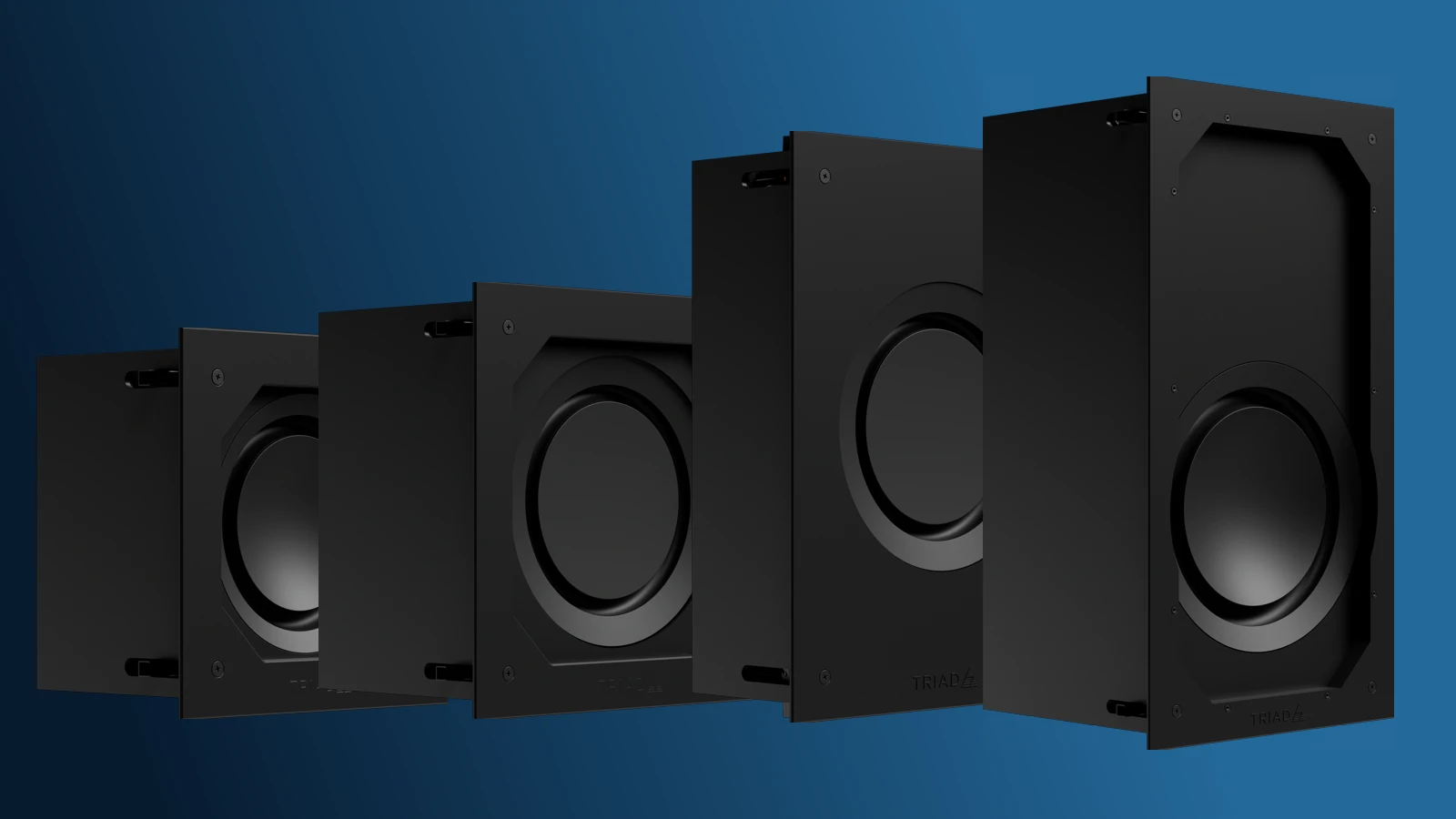
Four sealed architectural subwoofers, shown in order from compact in-ceiling to maximum-output in-wall.Fast answer: the InCeiling 8 is the compact 300W option, the InCeiling 10 reaches lower with a larger overhead enclosure, the InWall 10 delivers similar 300W capability from a shallow vertical form, and the InWall 12 is the 700W model for the deepest extension and highest-output rooms. Size, bass extension and structure increase together. Final selection must include the exact 4-ohm or 8-ohm load and matched DSP amplifier.
Four choices, side by side
All four use sealed, braced MDF enclosures, aluminum-cone drivers, spring terminals and a spring-dog installation system. The differences are where they fit, how low they play and how much structure and amplifier they require.
SMALLEST ENCLOSURE
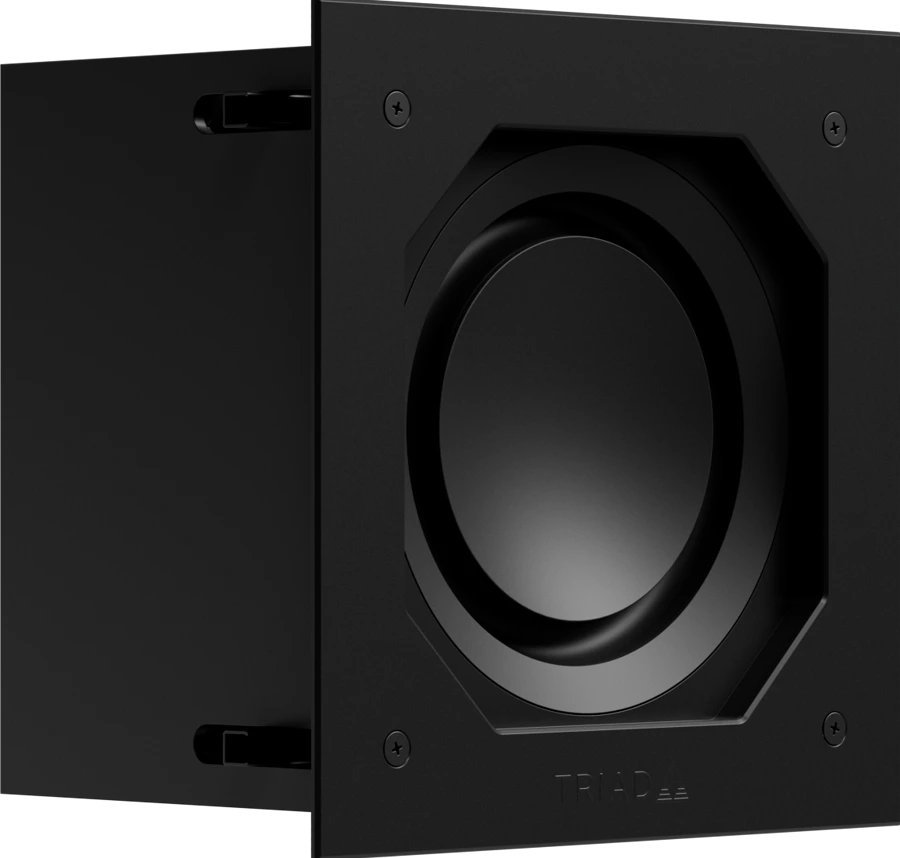
InCeiling 8
31–300 Hz (4Ω)300W RMS22 lb
A compact overhead option that preserves wall space and works where ceiling depth is more available than wall depth.
12 × 12 × 7.5-inch enclosure
4-ohm and 8-ohm versions
600W published peak power
Custom grille-color choices available
Best fit: smaller rooms and distributed-bass locations where a compact ceiling enclosure is the priority.
LOWER CEILING BASS
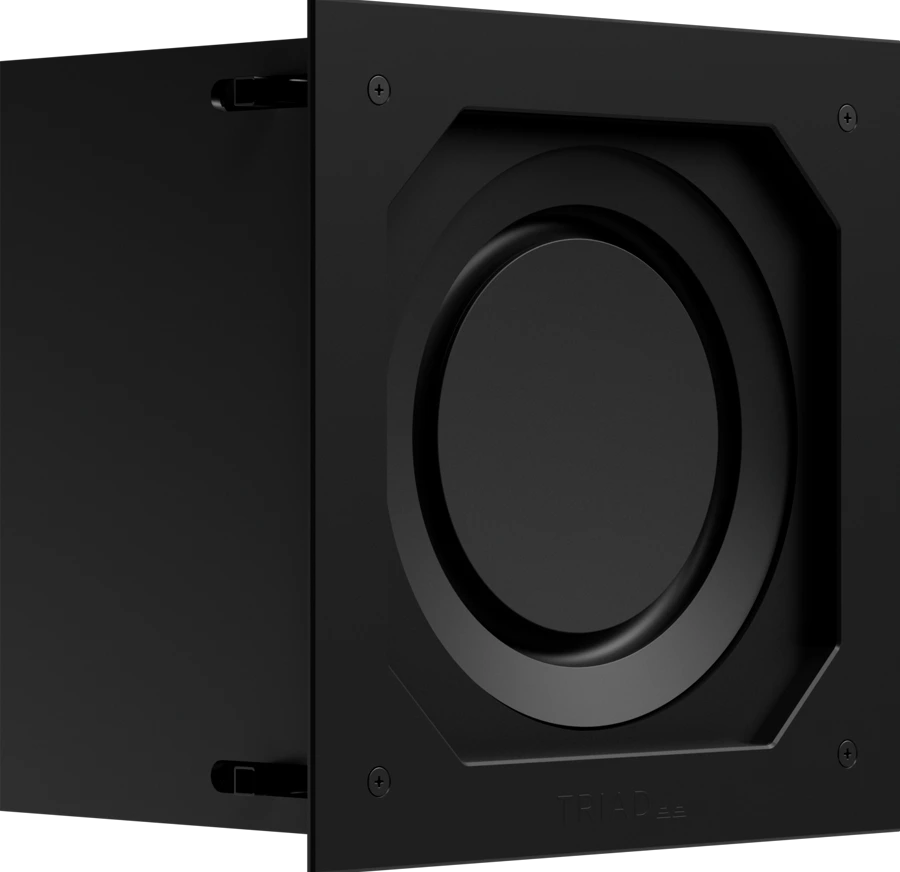
InCeiling 10
28–300 Hz300W RMS25.5 lb
The larger ceiling enclosure extends lower than the 8-inch model while keeping the visible grille overhead.
14.75 × 14.75 × 9-inch enclosure
4-ohm and 8-ohm versions
600W published peak power
Good balance of concealment and extension
Best fit: larger living spaces or theaters where wall locations are limited but a 9-inch-deep ceiling cavity is practical.
SHALLOW WALL FORMAT
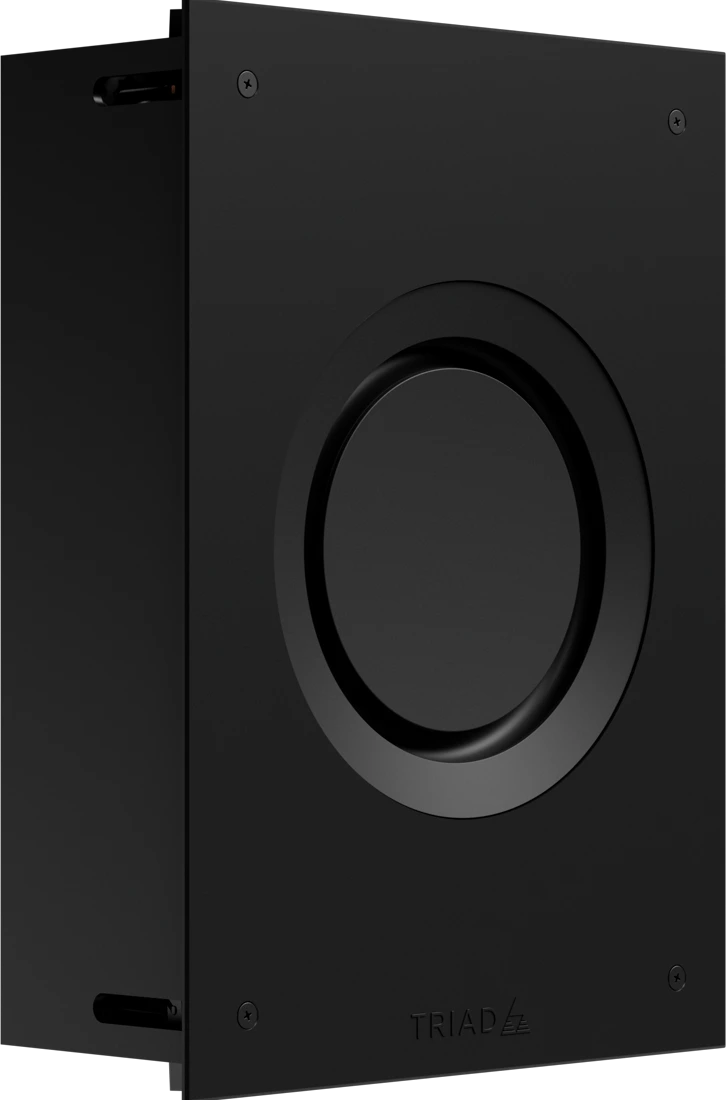
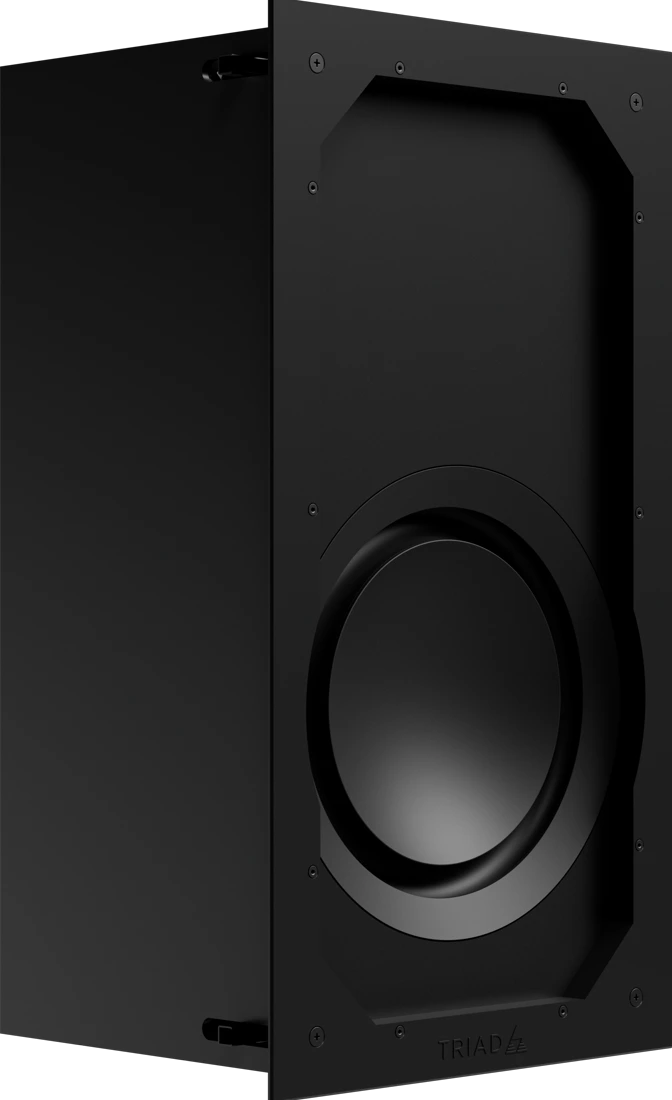
InWall 10
27–300 Hz (4Ω)300W RMS26.5 lb
A vertical enclosure that puts the grille low on the wall and avoids occupying floor space with a freestanding cabinet.
14.75 × 20.25 × 5.94-inch enclosure
4-ohm and 8-ohm versions
600W published peak power
Custom grille-color choices available
Best fit: media rooms and multipurpose spaces with a planned low-wall cavity and no room for a floor subwoofer.
DEEPEST + HIGHEST OUTPUT
InWall 12
19–300 Hz700W RMS56.5 lb
The largest model reaches the deepest published bass and handles more than twice the RMS power of the 8-inch and 10-inch choices.
14.75 × 27.25 × 11.5-inch enclosure
4-ohm and 8-ohm versions
1400W published peak power
Designed for demanding rooms and higher playback levels
Best fit: dedicated theaters and large rooms with purpose-built framing, adequate depth and a properly matched amplifier.
Current specification comparison
Model
Published response
Enclosure dimensions
Weight
RMS / peak
4Ω sensitivity
Primary planning advantage
TS-IC-PAS8 InCeiling 8
31–300 Hz (4Ω) 32–300 Hz (8Ω)
12 × 12 × 7.5 in
22 lb
300 / 600W
84 dB
Smallest enclosure and least ceiling depth
TS-IC-PAS10 InCeiling 10
28–300 Hz
14.75 × 14.75 × 9 in
25.5 lb
300 / 600W
88 dB
Stronger extension while keeping the grille overhead
TS-IW-PAS10 InWall 10
27–300 Hz (4Ω) 29–300 Hz (8Ω)
14.75 × 20.25 × 5.94 in
26.5 lb
300 / 600W
88 dB
Shallowest wall enclosure and no floor cabinet
TS-IW-PAS12 InWall 12
19–300 Hz
14.75 × 27.25 × 11.5 in
56.5 lb
700 / 1400W
88 dB
Deepest extension and highest output
Specifications were checked against the current official Snap One product pages on July 13, 2026. Sensitivity shown is for the 4-ohm version; 8-ohm sensitivity differs. Confirm the exact SKU, construction drawing, grille and amplifier compatibility chart before framing or ordering.
ROOM FIRST
The largest woofer is not automatically the best design
Low-frequency performance is a room problem as much as a product choice. One large subwoofer in a poor location can create strong bass in one seat and weak bass in another. Two correctly placed smaller subs may produce smoother coverage across several seats.
Map primary and secondary seating before choosing grille locations
Avoid selecting the only available cavity without considering room modes
Leave options for a second subwoofer where even coverage matters
Plan commissioning measurements, DSP, crossover, phase and delay
Design priority: choose the number and locations first, then choose the smallest models that meet the output and extension goal in those positions.
The 12-inch model earns its deeper extension with an 11.5-inch-deep, 56.5-pound enclosure.
In-ceiling or in-wall?
Choose in-ceiling when
Wall space is occupied by glazing, cabinetry or artwork and the ceiling has adequate depth, access and structure.
Choose in-wall when
A low wall position is acoustically useful and a purpose-built cavity can accept the enclosure depth and weight.
Watch the room above
Ceiling bass can transfer energy into upper floors. Isolation, framing and adjacent-room expectations must be discussed.
Watch the room behind
An in-wall enclosure may share structure with a bedroom, hallway or neighboring unit. Plan vibration and sound transmission.
Coordinate the grille
Place grille edges relative to trim, panels and furniture. Custom color helps, but alignment is still visible.
Preserve service access
The spring-dog system helps installation, but wire, terminals and the enclosure must still be removable without damaging finishes.
Amplifier and impedance are one decision
The current passive subwoofers are offered in 4-ohm and 8-ohm versions. Those are electrical system choices—not better and worse sound-quality tiers.
300WCompact 1U mono RackAmp with preset EQ modes; exact subwoofer compatibility must be confirmed.700WSingle-channel DSP RackAmp for more demanding matched subwoofer configurations.1200WSingle-channel DSP model for compatible high-output system designs.2 × 1200WThe 2400W RackAmp provides two channels for compatible multi-sub designs.
Important compatibility note: current Triad passive-subwoofer pages list compatibility with TS-SUBAMP300, TS-SUBAMP700 and other amplifiers with appropriate DSP, but explicitly state that these models are not compatible with the legacy Triad 2300-2. Use the current Triad compatibility chart for the exact model, impedance and quantity.
Prewire and framing checklist
1. Reserve the real enclosure
Use the published outer dimensions and construction drawing—not the grille size—to coordinate studs, joists, blocking and mechanical conflicts.
2. Verify structural support
These sealed cabinets weigh from 22 to 56.5 pounds. The finished assembly and vibration load need reliable structure.
3. Run appropriate speaker cable
Calculate conductor gauge from distance, impedance and amplifier power. Keep the route away from damage and label both ends.
4. Lock the amplifier plan
Record the exact 4-ohm or 8-ohm SKU, number of subs, series/parallel topology if applicable and matched DSP preset.
5. Coordinate the grille
Show grille outlines on elevations so they align with panels, baseboard, millwork, lighting and furniture.
6. Commission the room
Measure levels and response at the listening seats, then set crossover, EQ, phase, delay and protection deliberately.
Construction reality check: the InWall 10 is nearly 6 inches deep and the InWall 12 is 11.5 inches deep. Neither should be assumed to fit ordinary shallow framing without a coordinated enclosure location. The ceiling models require 7.5 or 9 inches of depth plus safe clearance from structure, ducts, plumbing, lighting and wiring.
A simple way to compare the options
“The 8-inch ceiling model is the compact choice. The 10-inch ceiling model reaches lower while staying overhead. The 10-inch wall model gives us similar power in a shallow vertical enclosure. The 12-inch wall model is for the deepest, highest-output bass—but it needs much more depth, structure and amplifier. We choose the location and room coverage first, then match the model and amp.”
Want the bass locations planned before framing and drywall?
Send Denali Tech the floor plan, ceiling plan, wall sections, seating layout and target listening level. We can map the subwoofer locations, cavities, grille elevations, wire, RackAmp and commissioning plan before construction closes.