CORE streams, music players, TV audio, turntable preamps and other analog or PCM digital sources.
What the matrix actually does
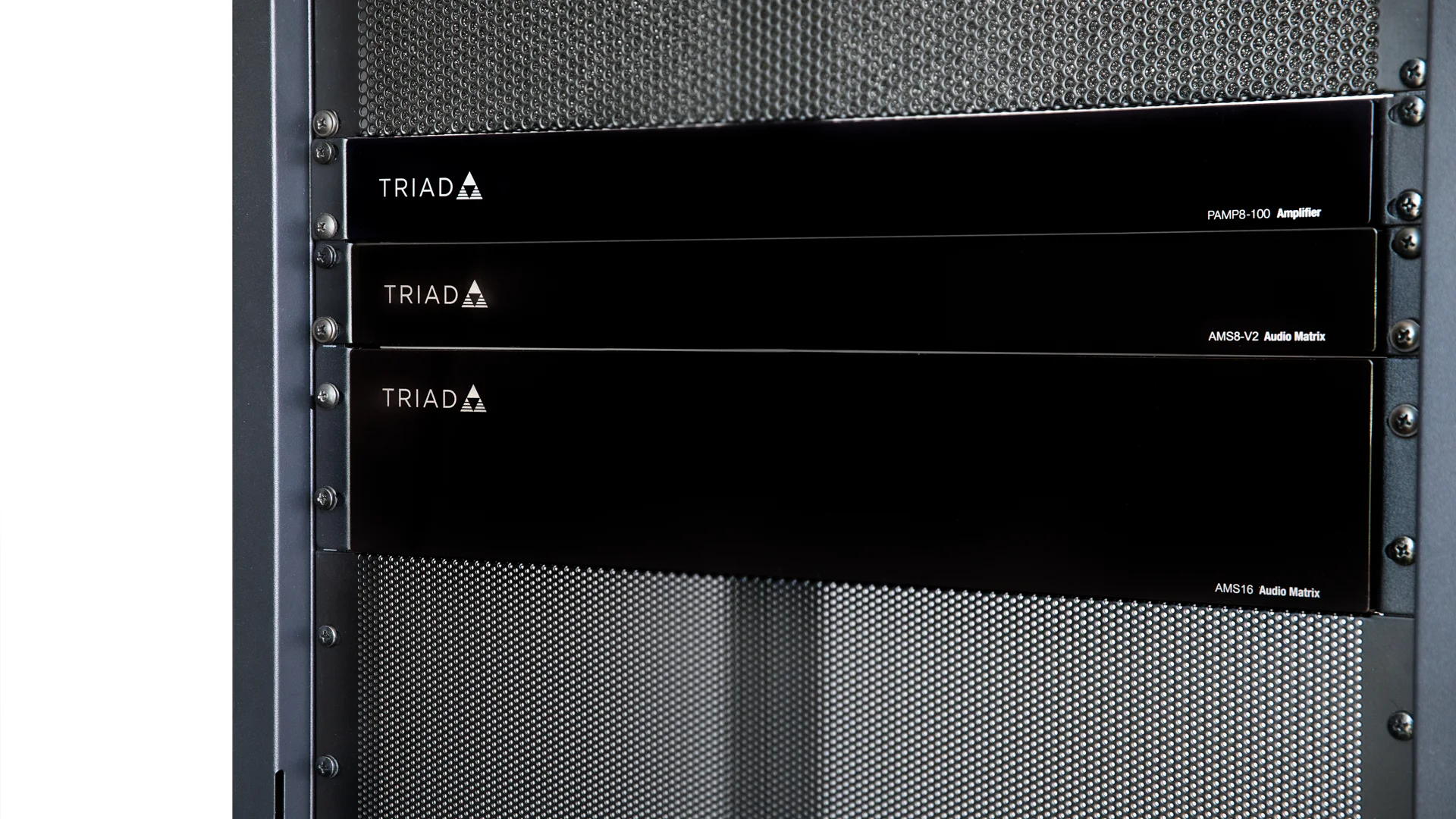
The matrix lets one family member play Apple Music in the kitchen, another listen to a turntable in the office, and everyone join the same playlist for a party. It keeps the sources centralized while rooms remain independent.
→
Selects which source feeds each room, then applies gain, EQ, delay, mono or 2.1 processing.
→
Convert the matrix’s line-level outputs into the wattage required by each speaker zone.
→
In-ceiling, in-wall, outdoor, soundbar and subwoofer systems in the rooms people use.
AMS8-V2 or AMS16?
The sound-quality platform is shared. The practical difference is how many sources and room outputs the system can route—and how much rack space the chassis uses.

8 SOURCES × 8 ZONES
AMS8-V2
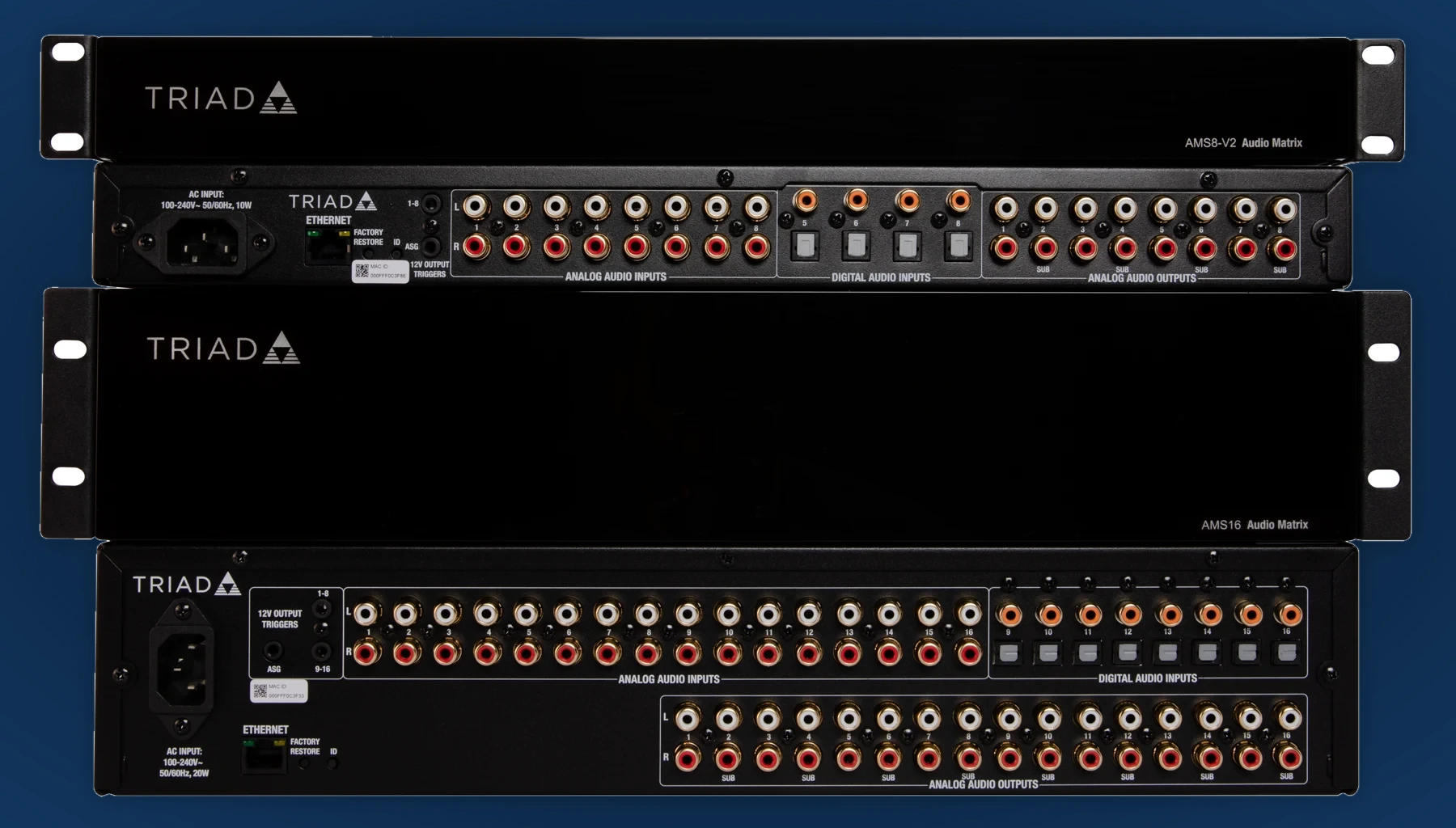
- Eight stereo analog inputs
- Four coaxial and four optical digital connections shared with inputs 5–8
- Eight stereo RCA zone outputs
- Compact 1U rack chassis
- High-resolution DSP and OvrC support
Best fit: a focused whole-home project whose completed zone and source schedule truly stays at eight or fewer.
16 SOURCES × 16 ZONES
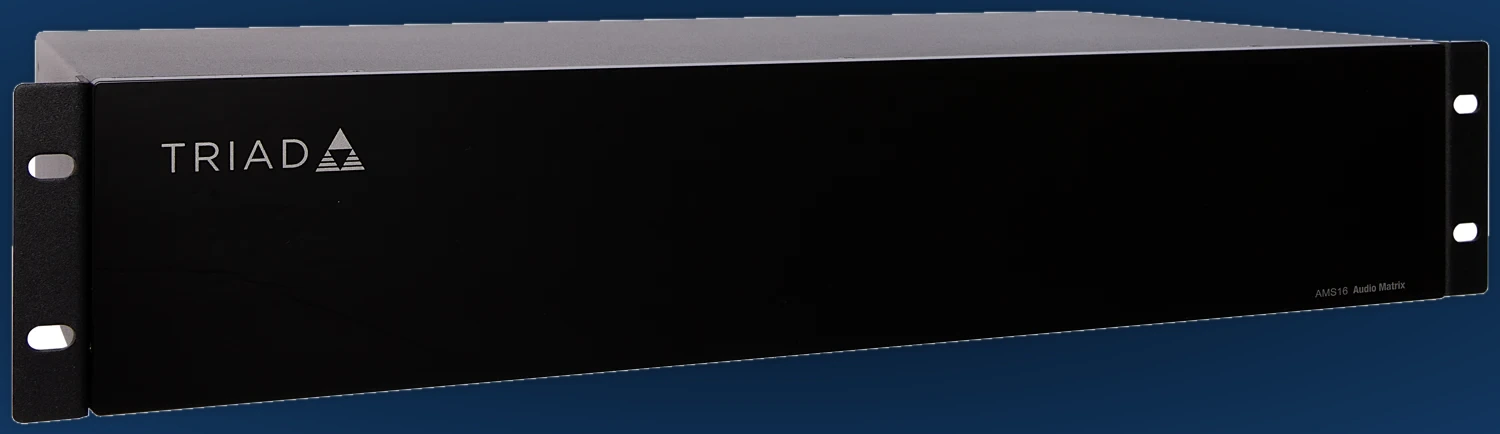
AMS16
- Sixteen stereo analog inputs
- Eight coaxial and eight optical digital connections shared with inputs 9–16
- Sixteen stereo RCA zone outputs
- 2U rack chassis
- More room for suites, outdoor zones and future expansion
Best fit: larger homes, multiple outdoor areas or designs where eight zones leave no safe growth margin.
Triad audio matrix specifications
| Decision | AMS8-V2 | AMS16 | Planning impact |
|---|---|---|---|
| Source capacity | 8 stereo sources | 16 stereo sources | Count every controller stream output, TV feed and external player that must be available simultaneously |
| Zone capacity | 8 stereo outputs | 16 stereo outputs | A room, patio or paired speaker area normally consumes one stereo zone |
| Analog inputs | 8 stereo RCA | 16 stereo RCA | External sources may need a phono preamp, DAC or audio extractor before reaching the matrix |
| Digital inputs | 4 coax + 4 optical; inputs 5–8 are analog or digital | 8 coax + 8 optical; inputs 9–16 are analog or digital | Digital inputs accept stereo PCM; compressed surround formats are not a whole-home matrix source |
| Audio resolution | Up to 192 kHz / 24 bit | Up to 192 kHz / 24 bit | The source, controller, matrix, amplifier and speaker path all affect the result |
| Room tuning | Volume, balance, bass, treble, six-band parametric EQ, mono summing and delay | Same | Each room can be calibrated independently rather than using one setting for the whole house |
| 2.1 support | Two adjacent outputs can form one stereo-plus-subwoofer zone | Same | A 2.1 zone consumes two matrix outputs; account for that before choosing chassis size |
| Rack space | 1U, 17.5 in wide × 10.38 in deep without feet | 2U, same width and depth | Reserve the matrix, amplifiers, ventilation, patching and service loops as one rack plan |
| Integration | Ethernet, SDDP, audio sensing, OvrC and 12V triggers | Same platform with additional trigger capacity | Control4 handles source selection and room control; OvrC improves remote support |
Specifications checked against the current official Triad AMS8-V2 / AMS16 data sheet. Exact firmware, driver, source-format and integration requirements should be confirmed for the project.
COUNT TWICE
Source count and room count are different
Eight rooms do not always mean eight sources. A CORE controller may supply several independent streaming outputs, while a television, turntable, media player or guest audio input consumes another matrix position.
- List every room or outdoor area that needs independent volume
- List every source that could play at the same time
- Include 2.1 rooms that use two adjacent outputs
- Keep a growth margin for future rooms and sources
- Do not count a home-theater surround system as a normal stereo room without reviewing the AVR signal path
Choose the architecture—not just the box
A dedicated matrix is one way to build whole-home audio. The best choice depends on the zone count, service expectations, speaker loads and how much routing flexibility your home needs.
Best when flexible source routing, room EQ, scalable amplification and a clearly serviceable central rack are priorities.
Episode Response amplifiers combine routing, DSP and speaker power in one chassis. They can reduce rack complexity in the right eight-zone design.
Useful for a room or small retrofit, but many separate boxes can create more power, network, shelf and account-management work at larger scale.
RACK PLANNING
The matrix is only the middle of the rack
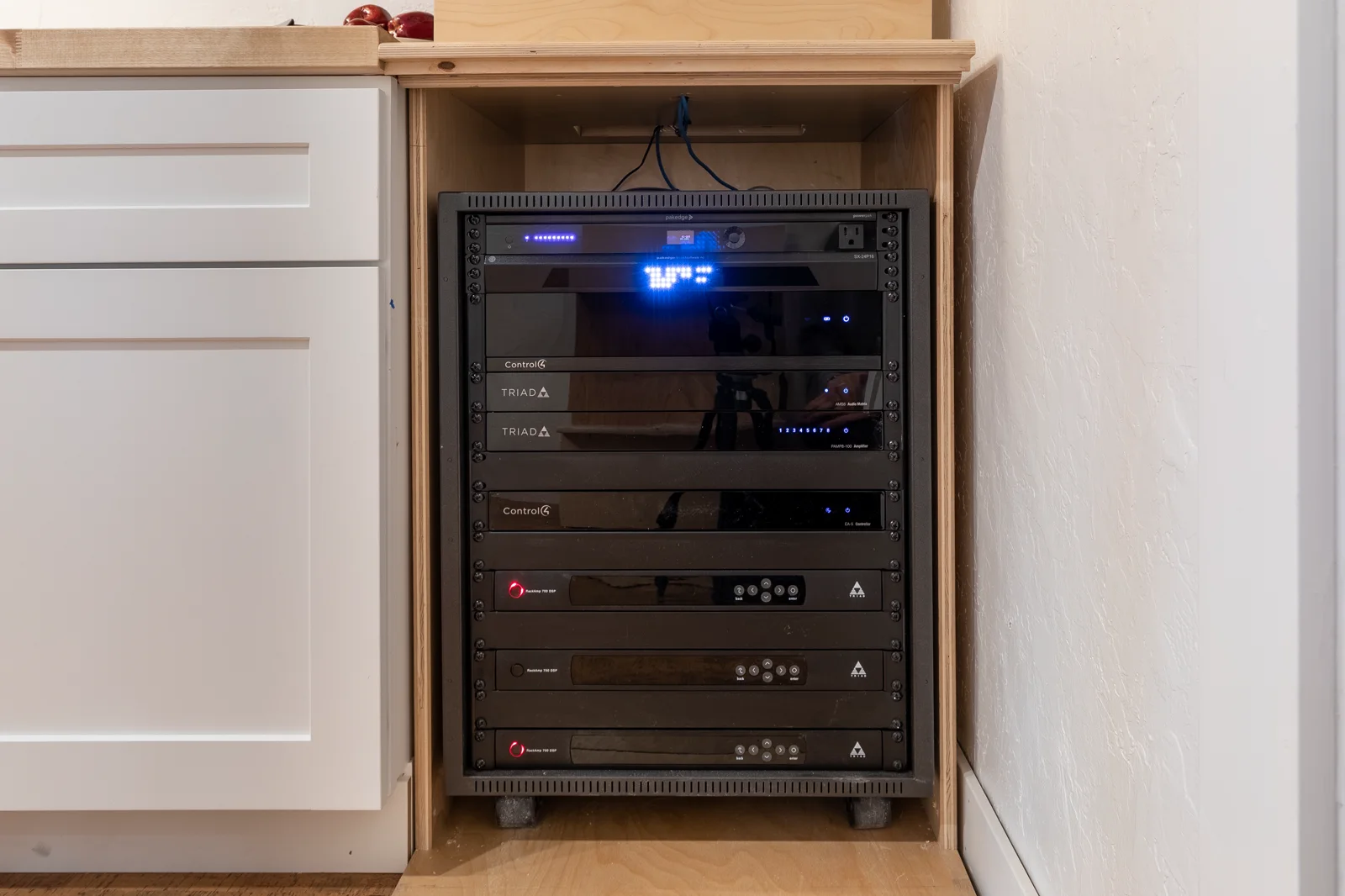
Every matrix output still needs amplification. The rack must also carry the Control4 controller, network, power management, source hardware and organized audio cabling.
- Reserve amplifier channels for every planned speaker load
- Leave ventilation around heat-producing amplifiers
- Label matrix inputs, outputs and speaker cables by room
- Keep short, serviceable RCA interconnects between matrix and amplifiers
- Use WattBox/OvrC power management for remote recovery where appropriate
- Document spare ports instead of hiding them in an unlabeled rack
Room-by-room planning worksheet
Kitchen background music, office critical listening, patio parties and bedroom audio do not need the same speaker or amplifier design.
Record quantity, impedance, power requirement and whether the zone is stereo, mono, 2.1 or 70V.
Decide which spaces need their own source and volume versus spaces that should always operate together.
Map streaming services, television audio, turntable, radio, guest input and stored music to physical matrix inputs.
Choose app, touchscreen, Halo remote, keypad favorites or voice for each room instead of giving every space the same control method.
Name the future patio, gym, guest suite or source now and reserve the required matrix and amplifier capacity.
Important signal-format rule: the matrix’s digital audio inputs accept stereo PCM. If television or video-source audio is part of the plan, the device must deliver a compatible two-channel signal or use the correct audio extraction/downmix path. Do not discover that requirement after walls and rack wiring are finished.
A simple way to compare the options
“The controller gives us the music streams. The matrix sends any stream or connected source to any room. The amplifiers provide the power. AMS8 handles up to eight sources and eight stereo zones; AMS16 doubles that capacity. We choose it from the completed room and source schedule, with enough space left for the way the home may grow.”
Want the whole-home audio zones mapped before prewire?
Send the floor plan, desired music rooms, outdoor areas, speaker preferences, television-audio requests and rack location. Denali Tech can build the source, matrix, amplifier and speaker schedule before wire is pulled or equipment is ordered.